
Decentralized AI: U.S. Startups Redefining Data Privacy and Control in 2024
The rapid evolution of Artificial Intelligence (AI) has brought unprecedented capabilities and efficiencies, but it has also cast a long shadow of concern over data privacy and control. As AI models become more sophisticated, their insatiable appetite for data raises critical questions about how personal and sensitive information is collected, stored, processed, and used. In response to these growing concerns, a burgeoning ecosystem of U.S. startups is pioneering a revolutionary approach: Decentralized AI Startups. These innovative companies are not just building better AI; they are fundamentally rethinking its architecture, aiming to empower individuals and organizations with greater autonomy over their data while harnessing the full potential of AI.
For years, the AI landscape has been dominated by a centralized model, where large corporations amass vast datasets in centralized servers, often leading to data breaches, privacy infringements, and a lack of transparency. This paradigm has fueled public distrust and regulatory scrutiny. However, the rise of decentralized AI offers a compelling alternative, promising a future where AI is more secure, transparent, and equitable. This article delves into how U.S. startups are leading this charge, exploring the technologies they employ, the challenges they face, and the transformative impact they are having on data privacy and control.
The Imperative for Decentralized AI
The need for decentralized AI has never been more urgent. In an era where data is often described as the new oil, its centralized control by a few powerful entities presents significant risks. These include:
Anúncios
- Privacy Concerns: Centralized data stores are prime targets for cyberattacks, and even legitimate uses can involve sharing sensitive personal information with third parties.
- Censorship and Bias: Centralized control can lead to algorithmic bias, where AI models reflect the biases of the data they were trained on, or even censorship, where certain information is suppressed.
- Lack of Transparency: The ‘black box’ nature of many centralized AI systems makes it difficult to understand how decisions are made, leading to a lack of accountability.
- Single Points of Failure: Centralized systems are vulnerable to single points of failure, meaning a breach or outage can have widespread consequences.
- Data Monopolies: The concentration of data in the hands of a few creates powerful data monopolies, stifling innovation and competition.
Decentralized AI Startups are directly addressing these issues by distributing data, processing, and decision-making across a network, rather than concentrating them in one place. This fundamental shift promises to usher in an era of AI that is not only more robust and secure but also more ethical and democratic.
Key Technologies Driving Decentralized AI
The vision of decentralized AI is powered by a confluence of groundbreaking technologies. U.S. startups are ingeniously combining these elements to build resilient and privacy-preserving AI systems.
Blockchain and Distributed Ledger Technologies (DLTs)
Blockchain, the underlying technology behind cryptocurrencies like Bitcoin and Ethereum, is a cornerstone of decentralized AI. Its inherent properties of immutability, transparency, and decentralization make it ideal for managing data access, ensuring data integrity, and creating verifiable audit trails. How Decentralized AI Startups leverage blockchain includes:
Anúncios
- Secure Data Sharing: Blockchain can facilitate secure, auditable, and permissioned data sharing without relying on a central authority. Data owners can control who accesses their data and under what conditions, with every interaction recorded on an immutable ledger.
- Decentralized AI Model Training: Instead of training models on a single, centralized dataset, blockchain can enable distributed training, where different parties contribute their data (or insights derived from their data) without exposing the raw information.
- Tokenization and Incentivization: Blockchain-based tokens can be used to incentivize participation in decentralized AI networks, rewarding individuals for contributing data, compute power, or model improvements. This creates a self-sustaining ecosystem where contributors are fairly compensated.
- Verifiable AI Outputs: The transparency of blockchain can be used to verify the provenance and integrity of AI models and their outputs, reducing concerns about manipulation or bias.
Federated Learning
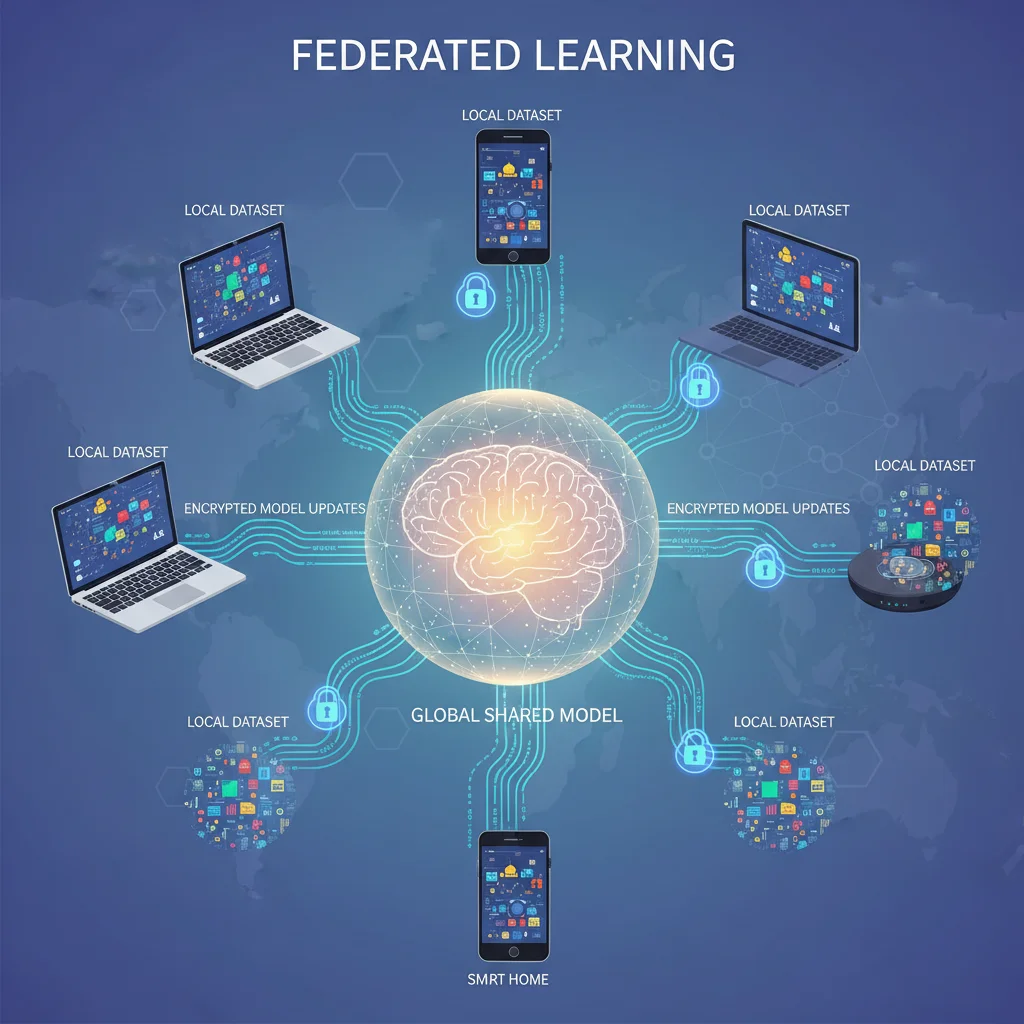
Federated learning is another pivotal technology that allows AI models to be trained on decentralized datasets without the need to centralize the raw data. This approach is particularly effective for privacy-sensitive applications. Here’s how it works:
- An AI model is initially trained on a central server.
- Copies of this model are then sent to various decentralized devices (e.g., smartphones, hospitals, edge devices), where they are trained locally on the device’s private data.
- Only the updated model parameters (not the raw data) are sent back to the central server.
- The central server aggregates these updates to create an improved global model.
This iterative process ensures that sensitive data never leaves its original location, significantly enhancing privacy. Decentralized AI Startups are adopting federated learning for applications ranging from healthcare diagnostics to personalized recommendations, offering a powerful way to build robust AI without compromising user privacy.
Homomorphic Encryption and Differential Privacy
Beyond federated learning, advanced cryptographic techniques like homomorphic encryption and differential privacy are crucial for bolstering data privacy in decentralized AI systems.
- Homomorphic Encryption: This allows computations to be performed on encrypted data without decrypting it. Imagine being able to run an AI algorithm on sensitive patient data without ever seeing the actual patient records in plain text. This is a game-changer for privacy-preserving AI.
- Differential Privacy: This technique adds a controlled amount of ‘noise’ to datasets or query results, making it statistically impossible to identify individual data points while still allowing for accurate aggregate analysis. It’s about protecting individual privacy while preserving the utility of the data for AI training.
These sophisticated methods, while computationally intensive, are being refined and integrated by U.S. Decentralized AI Startups to create truly privacy-by-design AI solutions.
U.S. Startups Leading the Decentralized AI Revolution
The United States is a hotbed of innovation, and its startup ecosystem is at the forefront of the decentralized AI movement. These companies are not just theoretical; they are building practical, scalable solutions across various sectors.
Healthcare and Medical Research
In healthcare, data privacy is paramount. Decentralized AI Startups are developing platforms that allow hospitals and research institutions to collaborate on AI model training using sensitive patient data without violating privacy regulations like HIPAA. By leveraging federated learning and homomorphic encryption, these startups enable medical AI to learn from diverse datasets, leading to more accurate diagnoses and personalized treatments, all while keeping patient records secure and localized.
Finance and Fintech
The financial sector deals with highly sensitive transactional data. Decentralized AI is being applied to fraud detection, credit scoring, and algorithmic trading. Startups are creating systems where financial institutions can collaboratively train AI models to identify anomalies or predict market trends without sharing proprietary customer data. This enhances security, reduces fraud, and fosters a more resilient financial ecosystem.
Supply Chain and Logistics
Supply chains are complex, involving multiple independent entities. Decentralized AI, often combined with blockchain, can optimize logistics, track goods, and predict demand more efficiently and transparently. Each participant can contribute their data to a shared AI model without revealing sensitive business operations to competitors, improving overall supply chain resilience and efficiency.
Personalized Services and Edge AI
From smart homes to wearable devices, edge AI is becoming ubiquitous. Decentralized AI Startups are enabling AI models to run and learn directly on user devices, enhancing personalization while keeping user data private. This means your smart assistant can learn your habits without sending your voice recordings to a central server, or your fitness tracker can analyze your health data without sharing it with a cloud provider.
The Advantages of Decentralized AI for Data Privacy and Control
The shift towards decentralized AI offers a multitude of benefits, particularly concerning data privacy and control:
- Enhanced Privacy: By keeping data localized and using privacy-preserving techniques, the risk of mass data breaches and unauthorized access is significantly reduced.
- Greater Data Control: Individuals and organizations regain control over their data, deciding who can access it, under what conditions, and for what purpose.
- Increased Security: Distributed systems are inherently more resilient to attacks, as there is no single point of failure to target.
- Improved Transparency and Auditability: Blockchain-based decentralized AI systems offer an immutable record of data usage and model changes, fostering greater trust and accountability.
- Reduced Bias: By enabling training on more diverse and representative datasets (without centralizing them), decentralized AI can help mitigate algorithmic bias.
- Fairer Data Economy: Tokenization and incentivization models can create a more equitable data economy where data contributors are compensated for their valuable input.
These advantages underscore why Decentralized AI Startups are not just a niche trend but a fundamental shift in how AI will be developed and deployed in the future.
Challenges and the Road Ahead
While the promise of decentralized AI is immense, the path forward is not without its challenges. U.S. startups in this space are actively working to overcome these hurdles:
- Scalability: Blockchain and advanced cryptographic methods can be computationally intensive, posing scalability challenges for large-scale AI applications. Research and development are focused on optimizing these technologies.
- Interoperability: Ensuring different decentralized AI platforms and blockchain networks can communicate and share information seamlessly is crucial for widespread adoption.
- Regulatory Landscape: The regulatory environment around AI and data privacy is still evolving. Startups must navigate complex legal frameworks and adapt to new regulations.
- Education and Adoption: The concepts behind decentralized AI can be complex. Educating businesses and consumers about its benefits and fostering adoption requires significant effort.
- Standardization: The lack of universal standards for decentralized AI development can hinder collaboration and slow down progress.
Despite these challenges, the rapid pace of innovation within the U.S. startup scene suggests that many of these obstacles will be overcome. Investment in decentralized AI technologies is growing, signaling strong confidence in its long-term potential.

The Future: A More Ethical and Empowering AI
The work being done by Decentralized AI Startups in the U.S. is not merely about technological advancement; it’s about building a more ethical and empowering future for AI. By prioritizing data privacy and control, these companies are laying the groundwork for AI systems that are trusted, transparent, and truly serve humanity’s best interests. Imagine a world where AI can personalize your healthcare, manage your finances, and optimize your daily life, all without you ever having to worry about your data being misused or compromised. This is the vision that decentralized AI promises.
As we move further into 2024, the impact of these innovative startups will only grow. Their efforts are shaping not just the technology itself, but also the societal norms and expectations around AI. The shift from centralized, data-hungry AI to a decentralized, privacy-preserving paradigm represents a critical inflection point in the history of artificial intelligence. It’s a move towards an AI that respects individual rights, fosters collaboration, and distributes power, rather than consolidating it.
The ongoing research into more efficient cryptographic techniques, the development of robust decentralized infrastructure, and the increasing awareness among consumers about data privacy are all contributing to a fertile ground for decentralized AI to flourish. We are witnessing the dawn of an era where AI can be both powerful and ethical, intelligent and trustworthy. The U.S. Decentralized AI Startups are at the vanguard of this exciting and essential transformation.
Conclusion
The journey towards a fully decentralized AI ecosystem is complex and multifaceted, but the dedication and innovation of U.S. startups are making it a tangible reality. By harnessing the power of blockchain, federated learning, homomorphic encryption, and other cutting-edge technologies, these companies are not just addressing the pressing concerns of data privacy and control; they are fundamentally redefining the relationship between humans, data, and artificial intelligence. The centralized model of AI, with its inherent vulnerabilities and ethical dilemmas, is slowly but surely giving way to a more distributed, secure, and user-centric approach.
As we look ahead, the continued growth and success of Decentralized AI Startups will be crucial in shaping an AI future that is not only technologically advanced but also ethically sound and socially responsible. Their work ensures that the immense power of AI is wielded in a manner that respects individual rights, promotes transparency, and ultimately, empowers everyone. The revolution is underway, and its impact will resonate for decades to come, promising a future where AI truly works for all, without compromising on our most fundamental right: privacy.
