Maximizing IoT Security: A 6-Step Guide for U.S. Smart City Infrastructure in 2024

Anúncios
The rapid evolution of smart cities across the United States brings with it unprecedented opportunities for efficiency, sustainability, and improved quality of life. From intelligent traffic management and smart grids to connected public safety and environmental monitoring, the Internet of Things (IoT) forms the backbone of these interconnected urban ecosystems. However, this interconnectedness also introduces a complex web of vulnerabilities, making robust IoT Smart City Security an absolute imperative. As we navigate 2024, the threat landscape continues to grow in sophistication and intensity, demanding proactive and comprehensive security strategies.
The stakes couldn’t be higher. A compromised smart city system could lead to widespread disruption, jeopardize public safety, expose sensitive citizen data, and undermine public trust in these innovative initiatives. Therefore, ensuring the resilience and integrity of IoT infrastructure is not just a technical challenge but a civic responsibility. This comprehensive guide outlines six critical steps U.S. smart cities must take to maximize their IoT Smart City Security, providing a framework for building a secure, sustainable, and trusted urban future.
Understanding the Evolving Threat Landscape for IoT Smart City Security
Before diving into solutions, it’s crucial to grasp the nature of the threats facing IoT Smart City Security. Unlike traditional IT environments, IoT deployments involve a vast array of devices, often with limited processing power, diverse operating systems, and extended lifespans, making patching and management challenging. Attack surfaces are expansive, ranging from individual sensors and actuators to cloud platforms and communication networks.
Anúncios
Common Threats Include:
- Device Tampering and Physical Attacks: IoT devices deployed in public spaces are susceptible to physical access, leading to data extraction or manipulation.
- Vulnerable Firmware and Software: Many IoT devices ship with default credentials or unpatched vulnerabilities, making them easy targets for exploitation.
- DDoS Attacks: Large-scale botnets comprising compromised IoT devices can launch devastating Distributed Denial of Service (DDoS) attacks, disrupting critical services.
- Data Breaches and Privacy Concerns: Smart city sensors collect vast amounts of data, including personal information, making them prime targets for data theft and privacy violations.
- Supply Chain Attacks: Compromises introduced at any stage of the IoT device supply chain, from manufacturing to deployment, can introduce backdoors or vulnerabilities.
- Ransomware and Extortion: Attacks that encrypt critical systems or hold services hostage for a ransom are an increasing concern for public infrastructure.
- Insider Threats: Malicious or negligent actions by authorized personnel can also pose significant risks.
The interconnected nature of smart city systems means that a breach in one domain, such as traffic management, could potentially cascade and affect other critical services like emergency response or power grids. This interconnectedness underscores the need for a holistic and integrated approach to IoT Smart City Security.
Step 1: Comprehensive Risk Assessment and Threat Modeling
The foundation of any robust security strategy is a thorough understanding of potential risks. For IoT Smart City Security, this means going beyond standard IT risk assessments. It requires a detailed inventory of all IoT devices, applications, and data flows within the smart city ecosystem.
Key Actions:
- Asset Identification: Document every IoT device, sensor, gateway, network component, and software application. Categorize them by criticality, data sensitivity, and potential impact if compromised.
- Threat Modeling: Proactively identify potential threats and vulnerabilities. This involves understanding how an attacker might exploit weaknesses in devices, networks, or applications. Techniques like STRIDE (Spoofing, Tampering, Repudiation, Information Disclosure, Denial of Service, Elevation of Privilege) can be valuable.
- Vulnerability Scanning and Penetration Testing: Regularly scan for known vulnerabilities in devices and software. Conduct ethical hacking (penetration testing) exercises to simulate real-world attacks and identify exploitable weaknesses before malicious actors do.
- Impact Analysis: Assess the potential consequences of a successful attack. What would be the financial cost, reputational damage, operational disruption, or impact on public safety?
- Regular Reviews: The smart city landscape is dynamic. Risk assessments should not be a one-time event but an ongoing process, updated as new technologies are deployed and threats evolve.
By systematically identifying and evaluating risks, smart cities can prioritize their security investments and allocate resources where they are most needed, ensuring the most critical assets are adequately protected. This proactive stance is fundamental to effective IoT Smart City Security.
Anúncios
Step 2: Implement a Zero-Trust Security Model
The traditional perimeter-based security model is insufficient for the distributed and diverse nature of IoT environments. A Zero-Trust model, which operates on the principle of ‘never trust, always verify,’ is essential for maximizing IoT Smart City Security.
Key Principles of Zero Trust for IoT:
- Strict Identity Verification: Every device, user, and application attempting to access resources must be authenticated and authorized, regardless of its location (inside or outside the network). This includes robust multi-factor authentication (MFA) for human users and strong device identity for IoT endpoints.
- Least Privilege Access: Grant only the minimum necessary permissions for any device or user to perform its function. This limits the lateral movement of an attacker if a single component is compromised.
- Micro-segmentation: Divide the network into small, isolated segments. This prevents a breach in one part of the network from spreading rapidly to other critical systems. For IoT, this means segmenting devices based on their function, criticality, and sensitivity of data they handle.
- Continuous Monitoring and Validation: Continuously monitor all network traffic and device behavior for anomalies and suspicious activities. Security posture is never static; it must be continuously evaluated and re-verified.
- Data Encryption Everywhere: Encrypt data at rest and in transit. This protects sensitive information even if it falls into the wrong hands.
Adopting a Zero-Trust approach significantly reduces the attack surface and enhances the resilience of smart city infrastructure against sophisticated cyber threats. It’s a paradigm shift that recognizes the inherent untrustworthiness of any network access request until proven otherwise, a critical component of modern IoT Smart City Security.
Step 3: Secure Device Lifecycle Management
The security of an IoT device begins long before it’s deployed and extends throughout its entire operational life. Effective device lifecycle management is paramount for sustainable IoT Smart City Security.
Phases of Secure Device Lifecycle:
- Secure Design and Procurement:
- Security by Design: Work with manufacturers to ensure security is baked into devices from the initial design phase, not bolted on afterward.
- Vendor Vetting: Establish strict security requirements for all IoT device vendors. Demand transparency regarding device components, software origins, and security certifications.
- Secure Boot and Hardware Root of Trust: Ensure devices utilize secure boot mechanisms and a hardware root of trust to prevent unauthorized firmware modifications.
- Secure Provisioning and Deployment:
- Unique Device Identities: Each device should have a unique, tamper-resistant identity (e.g., cryptographic certificates).
- Secure Onboarding: Implement secure onboarding processes that automatically configure devices with strong, unique credentials and connect them to segregated networks.
- Disable Default Credentials: Ensure all default usernames and passwords are changed immediately upon deployment.
- Ongoing Management and Maintenance:
- Patch Management: Establish a robust system for timely application of security patches and firmware updates. This is often challenging for IoT devices but absolutely critical.
- Configuration Management: Maintain secure configurations for all devices and regularly audit them for deviations.
- Vulnerability Management: Continuously monitor for new vulnerabilities affecting deployed devices and have a plan for rapid remediation.
- Cryptographic Key Management: Implement secure practices for generating, storing, and rotating cryptographic keys used by IoT devices.
- Secure Decommissioning:
- Data Sanitization: Ensure all sensitive data is securely wiped from devices before they are retired or repurposed.
- Secure Disposal: Dispose of devices in a manner that prevents data recovery or reuse for malicious purposes.
A proactive approach to device lifecycle management ensures that security is an ongoing consideration, not just a one-time setup. This continuous vigilance is a cornerstone of effective IoT Smart City Security.
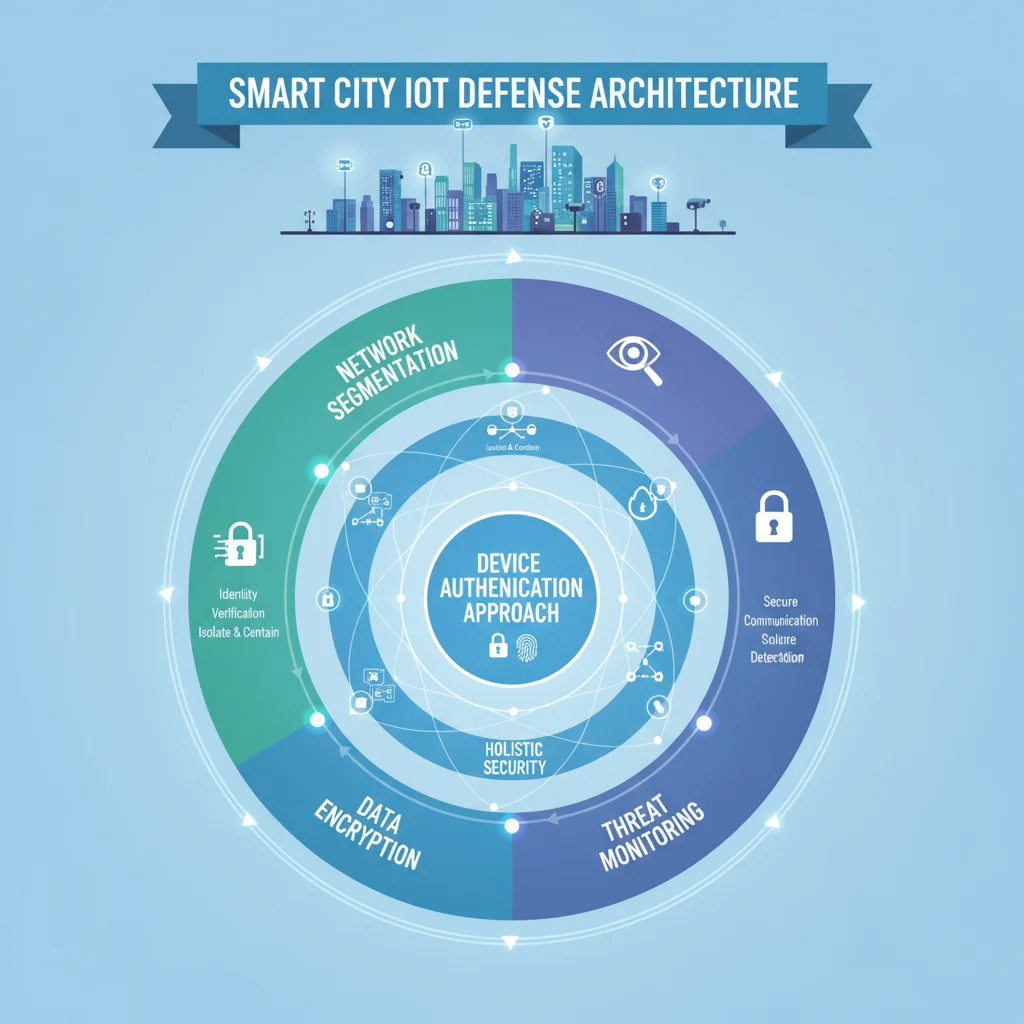
Step 4: Robust Network Segmentation and Secure Communication
Network infrastructure is the circulatory system of a smart city. Securing it is paramount to protecting the entire ecosystem. Implementing stringent network segmentation and ensuring secure communication protocols are vital for IoT Smart City Security.
Key Strategies:
- Logical Network Segmentation:
- Isolate Critical Systems: Create separate virtual local area networks (VLANs) or subnets for different smart city services (e.g., traffic control, public lighting, waste management, emergency services).
- IoT Device Segregation: Further segment IoT devices based on their function, criticality, and trust level. Devices handling sensitive data or controlling critical infrastructure should be in highly isolated segments.
- Operational Technology (OT) Network Separation: Strictly separate OT networks (e.g., smart grid control systems) from IT networks to prevent IT-based attacks from impacting critical infrastructure.
- Firewall and Intrusion Prevention Systems (IPS): Deploy robust firewalls and IPS at segmentation points to control traffic flow and detect/prevent malicious activity between segments.
- Secure Communication Protocols:
- Encryption in Transit: Mandate the use of strong encryption protocols (e.g., TLS 1.2/1.3, IPSec) for all data transmitted between IoT devices, gateways, and cloud platforms.
- Authenticated Communication: Ensure all communication endpoints are mutually authenticated before data exchange.
- Secure APIs: If IoT devices or platforms use Application Programming Interfaces (APIs), ensure they are secured with authentication, authorization, and rate limiting.
- Wireless Network Security: For Wi-Fi or other wireless IoT networks, implement strong encryption (WPA3), disable broadcast SSIDs, and use enterprise-grade authentication mechanisms.
- Secure Gateway Management: IoT gateways often act as intermediaries. Secure them rigorously with strong access controls, regular patching, and continuous monitoring.
By creating a layered and segmented network architecture, smart cities can contain potential breaches, limit their impact, and ensure that only authorized and secure communication occurs across the infrastructure. This forms a critical defensive barrier for IoT Smart City Security.
Step 5: Continuous Monitoring, Threat Detection, and Incident Response
Even with the most robust preventative measures, breaches can occur. Therefore, the ability to detect threats quickly and respond effectively is paramount for IoT Smart City Security. Continuous monitoring and a well-defined incident response plan are non-negotiable.
Core Components:
- Security Information and Event Management (SIEM) / Security Orchestration, Automation, and Response (SOAR):
- Centralized Logging: Aggregate logs from all IoT devices, networks, applications, and security tools into a central SIEM system.
- Real-time Analytics: Use SIEM/SOAR platforms to analyze logs in real-time, correlate events, and detect anomalies or indicators of compromise (IoCs).
- Automated Response: Leverage SOAR capabilities to automate routine security tasks, such as blocking malicious IPs, isolating compromised devices, or triggering alerts.
- Intrusion Detection Systems (IDS) / Intrusion Prevention Systems (IPS): Deploy network-based and host-based IDS/IPS solutions to monitor for suspicious network traffic patterns and device behavior.
- Behavioral Analytics: Utilize machine learning and AI-powered behavioral analytics to establish baselines of normal IoT device behavior. Deviations from these baselines can indicate a compromise.
- Threat Intelligence Integration: Integrate external threat intelligence feeds to stay updated on emerging threats, vulnerabilities, and attack methodologies relevant to smart city IoT.
- Dedicated Security Operations Center (SOC): Establish or partner with a SOC that can provide 24/7 monitoring, threat hunting, and incident response capabilities.
- Incident Response Plan (IRP): Develop a detailed, regularly tested IRP that outlines procedures for identifying, containing, eradicating, recovering from, and learning from security incidents. This includes communication protocols with stakeholders, including law enforcement and the public.
- Regular Drills and Exercises: Conduct tabletop exercises and simulated attack drills to test the effectiveness of the IRP and train personnel.
A proactive and responsive security posture, driven by continuous monitoring and a well-rehearsed incident response, is critical to minimizing the impact of any security breach on IoT Smart City Security.

Step 6: Cultivate a Culture of Security and Collaboration
Technology alone cannot guarantee security. Human factors, organizational culture, and inter-agency collaboration play an equally vital role in maximizing IoT Smart City Security. Cybersecurity is a shared responsibility.
Key Initiatives:
- Employee Training and Awareness:
- Regular Training: Provide continuous cybersecurity awareness training for all smart city personnel, from IT staff to urban planners and operational teams.
- Phishing Simulations: Conduct regular phishing simulations to educate employees about social engineering tactics.
- Best Practices: Emphasize strong password policies, secure browsing habits, and the importance of reporting suspicious activities.
- Cross-Departmental Collaboration:
- Security-by-Default Mindset: Foster a culture where security is a consideration from the outset of any smart city project, not an afterthought.
- Regular Communication: Establish clear communication channels between IT, OT, physical security, legal, and executive leadership to ensure a unified security strategy.
- Public-Private Partnerships:
- Industry Collaboration: Engage with cybersecurity vendors, research institutions, and industry forums to stay abreast of the latest threats and best practices.
- Information Sharing: Participate in information sharing and analysis centers (ISACs) or other threat intelligence-sharing initiatives relevant to critical infrastructure.
- Regulatory Compliance and Governance:
- Adherence to Standards: Comply with relevant cybersecurity regulations, standards, and frameworks (e.g., NIST Cybersecurity Framework, ISO 27001).
- Clear Policies: Develop and enforce clear security policies and procedures for all aspects of smart city operations.
- Regular Audits: Conduct independent security audits to ensure compliance and identify areas for improvement.
- Citizen Engagement and Transparency:
- Privacy by Design: Integrate privacy considerations into all smart city projects, ensuring data minimization and transparency in data collection and usage.
- Public Trust: Communicate security measures and privacy protections to citizens to build and maintain trust in smart city initiatives.
By investing in people, processes, and partnerships, smart cities can create a resilient security ecosystem that is well-equipped to face the challenges of the digital age. This human element is as crucial as any technological safeguard in ensuring robust IoT Smart City Security.
The Future of IoT Smart City Security: Emerging Trends
As smart cities continue to evolve, so too will the methods for securing them. Staying ahead of the curve requires an understanding of emerging trends in IoT Smart City Security:
- AI and Machine Learning for Anomaly Detection: Advanced AI algorithms will become even more critical for detecting subtle anomalies in vast IoT data streams that indicate sophisticated attacks.
- Quantum-Resistant Cryptography: With the advent of quantum computing, the need for cryptographic algorithms that can withstand quantum attacks will become paramount for long-term data security.
- Decentralized Identity and Blockchain: Blockchain technology could offer new ways to manage immutable device identities and secure data transactions, enhancing trust and transparency.
- Digital Twins for Security Simulation: Creating digital replicas of smart city infrastructure can allow for safe simulation of cyberattacks and testing of defense strategies without impacting live systems.
- Edge Computing Security: As more processing moves to the network edge, securing edge devices and gateways will become even more critical, reducing reliance on centralized cloud systems.
- Automated Compliance and Governance: Tools that can automatically monitor and report on compliance with security policies and regulatory requirements will streamline governance efforts.
Embracing these advancements, while continuously refining existing strategies, will be key to maintaining a leading edge in IoT Smart City Security.
Conclusion: A Secure Foundation for the Smart City Dream
The vision of a smart city – efficient, sustainable, and responsive to its citizens’ needs – is within reach for many U.S. municipalities. However, realizing this vision responsibly hinges entirely on the strength of its underlying IoT Smart City Security. The six steps outlined in this guide – comprehensive risk assessment, Zero-Trust implementation, secure device lifecycle management, robust network segmentation, continuous monitoring and incident response, and a strong culture of security and collaboration – provide a strategic roadmap for safeguarding these complex and vital urban ecosystems.
Investing in robust cybersecurity is not merely a cost but an investment in the future resilience, functionality, and public trust of smart cities. By prioritizing these security measures in 2024 and beyond, U.S. cities can ensure that their smart infrastructure serves as a beacon of innovation, rather than a vector for vulnerability. The journey to a truly smart and secure city is ongoing, requiring constant vigilance, adaptation, and a commitment to protecting the digital heart of our urban future.
